

Updated:
Originally Published:
Updated:
March 30, 2026
________________________________________________________________________________________________
As demands on the U.S. power grid grow exponentially, utilities need solutions that not only expand capacity but also address an increasingly complex array of considerations.
In addition to conventional substations and switchyards, utilities need solutions that improve the efficiency of transmitting electricity over long distances, that can expand capacity without increasing station footprints, and that maximize renewable generation sources.
Previously rare project types, like gas-insulated switchgear (GIS) substations or series capacitors, are now much more common. Yet utility procurement teams may not have experience with evaluating the costs and benefits of these grid solutions, and utility engineering teams may be unfamiliar with these technologies or not have standards built for them.
In this post, you'll get a snapshot of each system’s capabilities and its pros and cons so you can make more informed asset planning and procurement decisions for your team.
As cities grow, so do their power needs. Stations that were once in remote areas are now surrounded by neighborhoods, with nowhere to expand when the grid needs more capacity.
Gas-insulated switchgear stations are a popular choice in these situations. GIS stations use the gas sulfur hexafluoride (SF6) for insulation instead of conventional air insulation. This allows for smaller electrical equipment clearances and shrinks the station's footprint by up to 80% compared to a conventional air-insulated (AIS) station. As a result, utilities can expand existing brownfield stations to higher voltages with more power capacity while remaining within a small footprint—a feature that makes GIS a popular solution in urban areas with high property values and little room to expand.
The compact nature of GIS also means it works well in sensitive areas where stations need to be protected inside buildings, behind walls, or elevated on piers due to physical security concerns, corrosive environments (near chemical plants or saltwater), or flood zones.
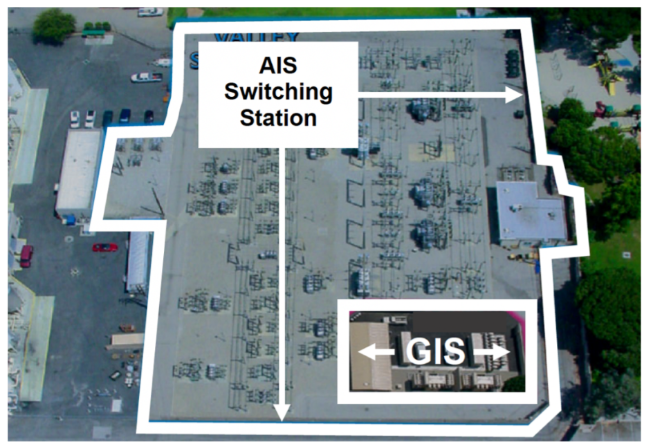
The primary original equipment manufacturers (OEMs) in the GIS market are General Electric, Hitachi (formerly ABB), Mitsubishi Electric Power Products, Inc. (MEPPI), and Siemens Energy. As with other major equipment for substations, GIS can have long lead times—with 69kV gear at about 16 months, 138kV at 16–17 months, 230kV at 18–19 months, 345kV at 19–20 months, and 500kV at 20–22 months as of March 2026 (estimates include 2 months for overseas transportation to a U.S. jobsite).
Dig Deeper: Gas-insulated solutions are also available for transmission lines (known as gas-insulated lines, or GIL). These are typically used for short distances in highly sensitive areas, such as metropolitan areas or tunnels, where overhead transmission lines would be difficult to install.

Flexible AC Transmission Systems (FACTS) are a family of power electronics-based devices used to enhance alternating current system control and stability, improving power quality and reliability for power grid systems and enhancing control flexibility for utilities and grid operators. FACTS solutions include series capacitor banks, static VAR compensators, STATCOM, and synchronous condensers.
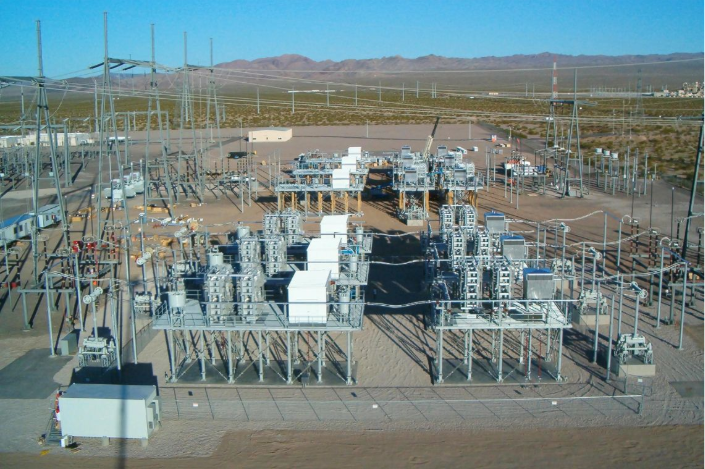
Factory-Built Substations (FBS) are modular, prefabricated projects that look and function like standard stations once installed. Even with minor modular design modifications to meet transportation constraints, they can be built to utility standards.
Agile by Beta® is a turnkey service Beta Engineering provides that includes the engineering, procurement, site prep, and FBS installation.
The same factors that make Factory-Built Substations ideal for renewable projects, such as reduced time on site and increased schedule certainty, can also apply to utilities, data center developers, and industrial plants.
Case Study: Factory-Built Meets Stick-Built: A Dual EPC Approach Interconnecting Solar to the Grid
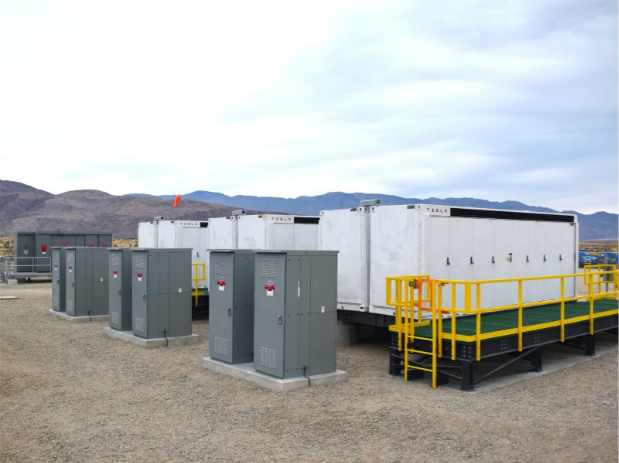
Battery Energy Storage Systems (BESS) are banks of battery modules that allow power providers to store power and then deploy it when needed—a service predominantly needed for weather-dependent energy sources like solar and wind.
Even with a cooling market for clean energy development, BESS projects have remained a steady priority for utility project queues since as early as 2016 because they facilitate a steady supply clean energy and are often a cheaper source of backup power during an emergency than natural gas—which often experiences price spikes during major weather events like Winter Storm Uri in 2021 in Texas.
When utilities need to transmit large amounts of power over long distances, extra-high-voltage projects come into play, as seen in 2025 and 2026 with plans for 765kV transmission lines in Texas. Increasing voltage reduces electricity losses, making EHV transmission lines an efficient option that can ultimately save utilities and ratepayers money.
According to the American National Standards Institute (ANSI), systems higher than 230kV, such as 345kV, 500kV, and 765kV, are considered extra-high-voltage.
These project approaches give utilities an array of options to tackle their unique project challenges. Keep these approaches in mind to achieve the following objectives:
Together, these solutions can help the U.S. power grid meet the challenges of aging infrastructure, larger loads, and increasing urban and brownfield substation builds.
Have questions? Reach out to Beta Engineering’s team of EPC experts to tap into over 50 years of high-voltage problem-solving and ensure your next RFP is set up for success.
Beta Engineering is a substation EPC company headquartered in Pineville, LA, with an office in San Diego. Since 1975, we’ve helped utilities, renewable developers, and other power delivery companies across the U.S. complete high-voltage substation and transmission line projects.


